

BLOG POST
February 2026
With Josh Hinkemeyer, Ipsen Engineering Manager
Introduction
Design for Manufacturing and Assembly (DFMA) is more than a design philosophy. It is a practical framework Ipsen uses to deliver heat-treating equipment that is reliable, repeatable, and serviceable throughout its lifecycle.
At Ipsen, DFMA principles are applied long before a furnace is built, beginning during concept development, system layout, component selection, and modular design. This approach helps customers reduce risk, shorten installation timelines, and maintain consistent performance year after year.
Designing with the Entire Lifecycle in Mind
For heat-treating equipment, design decisions do not just affect initial build cost. They influence installation time, uptime, maintenance effort, and long-term operating expenses.
Ipsen applies DFMA early in the design process to ensure that:
- Systems are manufacturable using proven processes
- Assemblies are repeatable and consistent across builds
- Components are accessible for service and replacement.
- Variability is minimized from one furnace to the next.
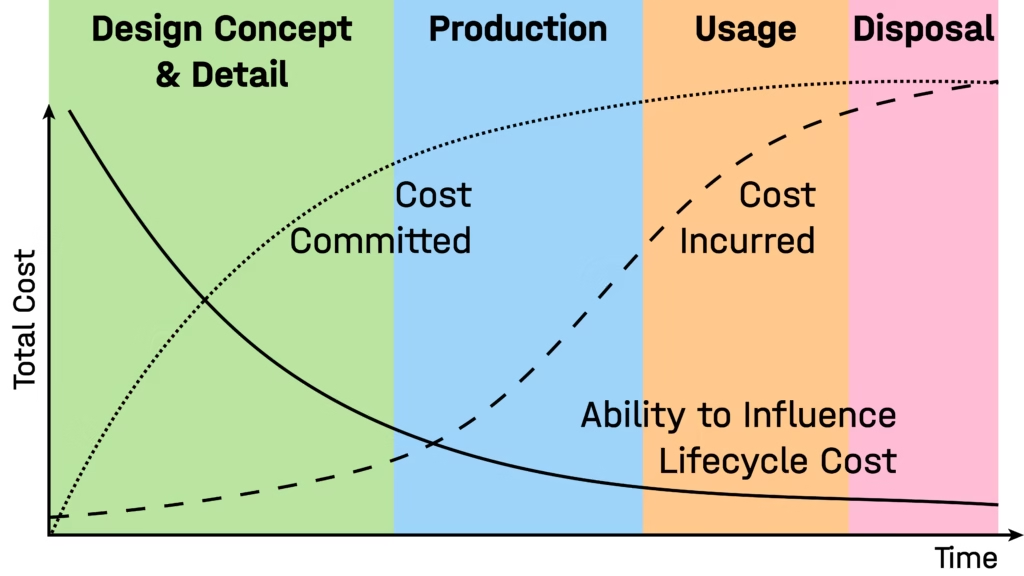
Figure: Ability to Influence Lifecycle Cost vs. Cost Incurred Over Time
(source: allaboutlean.com)
Early design decisions commit a majority of a product’s total lifecycle cost, even though most costs are incurred later during production, use, and disposal. DFMA focuses on maximizing cost influence during the design phase, when changes are least expensive and most effective.
By addressing any concerns upfront, Ipsen helps customers avoid downstream issues that can impact production schedules and throughput.
Design for Manufacturing (DFM) vs. Design for Assembly (DFA)
Design for Manufacturing
DFM focuses on how individual parts are produced. It
emphasizes material selection, machining methods, tolerances, and fabrication techniques that reduce manufacturing time, cost,
and variability.
Design for Assembly
DFA focuses on how parts come together into a complete system. It emphasizes reducing part count, simplifying assembly steps, improving access, and minimizing opportunities for assembly error.
DFMA
DFMA combines both perspectives, ensuring equipment is designed to be practical to manufacture and efficient to assemble, service, and support over its lifecycle.
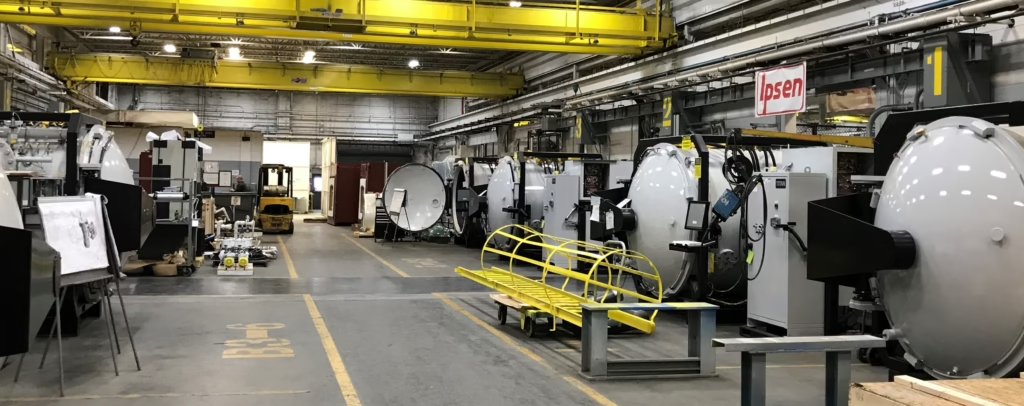
Design for Manufacturing
Ipsen designs around standardized components and proven modules wherever possible. This reduces unnecessary customization while improving build quality and lead-time predictability.
For customers, this means:
- More consistent furnace performance
- Faster manufacturing and assembly timelines
- Easier sourcing of replacement parts
- Reduced risk tied to one-off components
Standardization allows Ipsen’s engineering and manufacturing teams to continuously refine designs based on real-world performance data.
This consistency also benefits Ipsen’s Field Service Team. When components and system architecture are consistent across a product line, service engineers develop a strong baseline understanding of normal system behavior. That familiarity allows them to quickly identify abnormalities, isolate root causes, and resolve issues more efficiently. For customers, this translates into faster troubleshooting and reduced downtime.
Efficient Fabrication
Ipsen engineers design vessels, frames, and components with manufacturing realities in mind, including raw material sizes, machining processes, tolerances, and weld accessibility.
The DFM-driven Approach:
- Reduces unnecessary machining and rework
- Improves dimensional repeatability
- Minimizes distortion in welded assemblies
- Supports consistent quality across builds
Design for Assembly
Ipsen applies DFA principles by designing furnaces as modular systems and subassemblies, such as standardized vessels, pump skids, and support systems.
For customers, modularity delivers real advantages:
- Shorter installation and commissioning timelines
- Easier upgrades and retrofits
- Simplified troubleshooting and maintenance
- Improved serviceability over the equipment’s lifespan
Modules are designed to integrate cleanly while maintaining flexibility for application-specific requirements.
Service Access and Maintainability
DFA at Ipsen extends beyond initial assembly. Components are positioned to allow reasonable access for inspection, maintenance, and replacement, which helps reduce service time and downtime. This focus supports long-term uptime, not just initial delivery.
Designing with Service in Mind Helps Customers:
- Reduce mean time to repair (MTTR)
- Perform routine maintenance more efficiently
- Extend the usable life of the system
Reducing Complexity Without Sacrificing Performance
Heat-treating applications often require precise control, tight tolerances, and reliable performance. DFMA helps Ipsen balance those requirements with manufacturability and assembly efficiency. This disciplined approach results in systems that perform as intended without introducing unnecessary cost or risk.
IPSEN ENGINEERS
APPLY DFMA
PRINCIPLES TO:
Select materials and components that are appropriate for the application and not over-engineered
Use the loosest tolerances that still
meet process requirements
Eliminate features that add cost but no value
What DFMA Means for Ipsen Customers
By applying DFMA throughout design and development, Ipsen helps customers achieve:
- Predictable system performance
- Reduced installation and commissioning time
- Improved reliability and repeatability
- Easier maintenance and serviceability
- Lower total cost of ownership
Rather than treating manufacturing and assembly as afterthoughts, Ipsen designs equipment with real-world production, service, and operational realities in mind.
DFMA as Part of the Ipsen Engineering Culture
DFMA is not a checklist. It is embedded in how Ipsen engineers think about equipment design. By continuously refining standard components, modular systems, and manufacturing processes, Ipsen delivers heat-treating solutions that balance performance, reliability, and long-term value.
For customers, this translates into equipment designed not only to meet specifications, but to support production success over decades of operation.
Sources
This article was researched and informed by the following
DFMA references:
 English
  German
  Chinese
  Japanese
  Italian
  French
  Spanish