

The Rockwell Hardness Scale is a measurement of a material’s resistance to penetration or permanent deformation when encountering force from another material. Penetrations include surface breaks, such as punches or scratches. Permanent deformations include dents, buckles, or compression fractures.
When machining a metal tool, such as a die block or a cutting tool, the raw material must be malleable enough to be cut or shaped into its final functional form. The best materials at this stage of the process would have a lower Rockwell hardness rating than the cutting and shaping tools used to form them.
Once a part has achieved its final form, that part then needs to be made hard enough to remain in that form over the lifetime of its use. For example, engine piston surfaces may need to be hard enough to withstand billions of tiny explosions and the friction of the motion inside the engine cylinders over their lifetime. These materials need to be rated highly on the Rockwell hardness scale.
Hardening, by way of heat treating, is the crucial step that takes metal materials from malleable and machinable to durable and resistant to penetration and deformation.
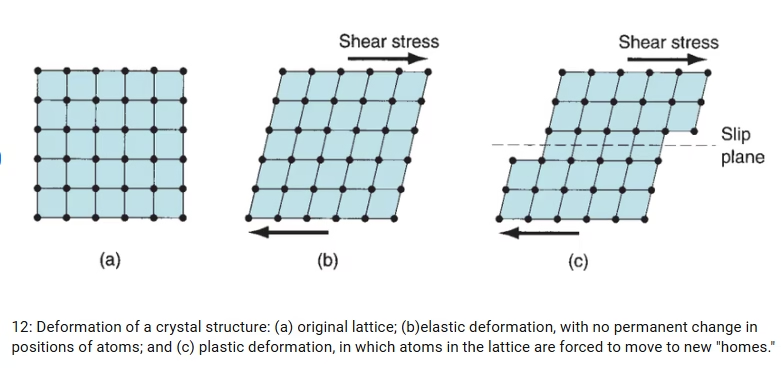
Heat-treatment hardening takes a metal part and applies enough heat to transform the internal crystal lattice structure (see sidebar), making it more resistant to penetration and deformation. The process results in an internal crystal lattice structure that has fewer and shorter shear planes.2
Shear planes, occasionally also known as slip planes, are areas within a solid material where clusters of atoms or molecules can easily slide past one another. Those shear planes represent weaknesses, where deformations or penetrations are most likely to happen.

The Crystal Structure of Metal
All known metallic elements except mercury are solid and crystalline at room temperature. Metals and their alloys have a strong tendency to crystallize, with atoms arranged in ordered, repeating patterns rather than randomly.
The crystalline structure of most metals at room temperature is one of three common types: body-centered cubic (BCC), face-centered cubic (FCC), or hexagonal close packed (HCP).1
These crystal structures influence how easily atoms can move relative to each other, which in turn affects the metal’s strength, ductility, and deformation behavior when a force is applied.
What is the difference between Case Hardening and Quench Hardening?
There are two hardening methods that heat treaters frequently use to increase hardness in metals – case hardening and quench hardening.
Case Hardening
Case hardening is the diffusion of one or more elements at high temperatures into a metal. These elements disrupt the uniformity of a crystal lattice, which can change the shape of a line or flat plane in a uniform material into something more jagged.3
These processes are used most frequently with ferric metals such as steel. Carburizing, nitriding, and carbonitriding are the most common versions of case hardening.
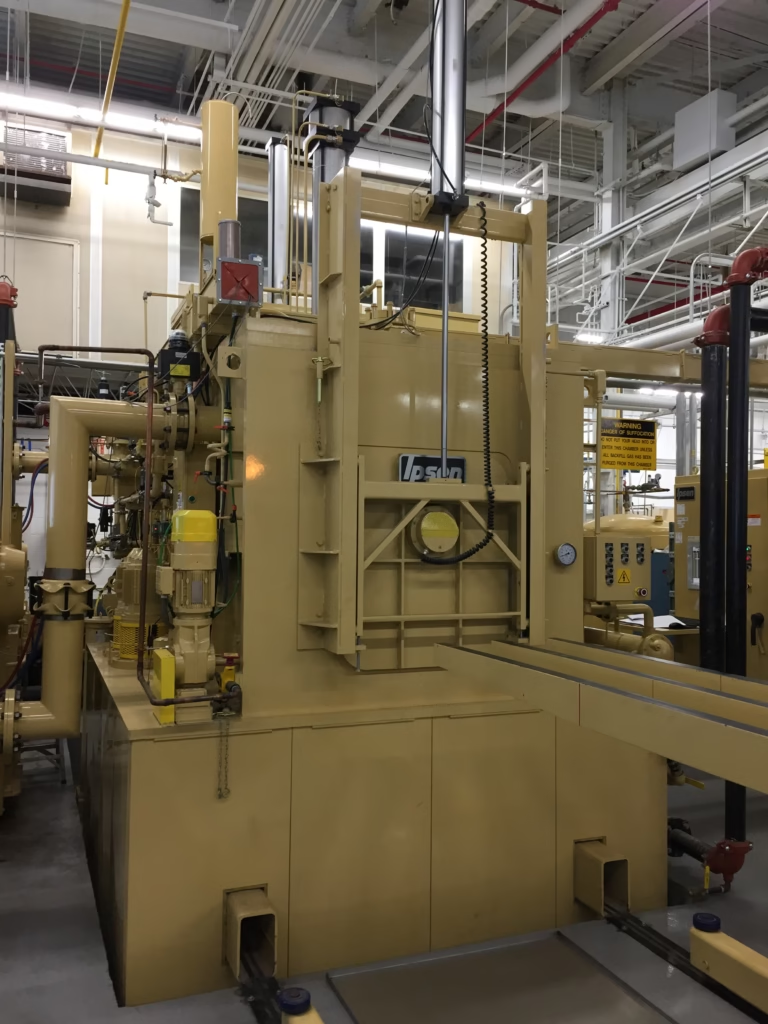
Most case hardening happens in atmosphere furnaces, like an Ipsen Atlas furnace. Parts enter the furnace and are heated to a temperature where the process gas can diffuse elements like carbon, nitrogen, or both, into the surface metal of the parts. They do this by introducing process gases like acetylene, ammonia, carbon dioxide, or carbon monoxide into the system. Sometimes, hydrogen is introduced to remove surface oxides for a more effective bond.
There are some instances when case hardening requires the use of a vacuum furnace. Examples include parts that mandate high cleanliness, require uniform case depth hardness, or have complex geometries. One such method for case hardening in a vacuum furnace is Ipsen Avac® low-pressure carburizing.

Quench Hardening
Quench hardening is created not by adding material to a metal, but by raising the metal’s temperature until the crystal lattice structure reaches the austenite state, then rapidly quenching the material until it settles into a martensite crystalline state. This quench process needs to be fast enough to avoid forming other crystalline structures, such as ferrite, perlite, and bainite.4
Quench hardening can be accomplished both by vacuum furnaces and atmosphere furnaces, though only alloys with high levels of alloying elements can be vacuum hardened.
Quench hardening can be performed using a liquid quenching solution, such as oil, salt, or water, or with a high-pressure, circulating, unreactive gas, such as argon or nitrogen. While some vacuum furnaces, such as the Ipsen LOG Furnace5, can provide a flexible quench solution using “Liquid Or Gas,” most vacuum furnaces only use pressurized gas for quenching.
Gas quench vacuum furnaces are usually rated by their pressure capability. Most Ipsen furnaces can deliver anywhere from a 2-bar gas quench up to a 20-bar quench pressure. As a guideline, tripling the pressure can cut quenching time in half; the gas has more molecules to absorb heat from the parts and the chamber. At a certain point, however, high-pressure gas quench can’t accomplish the speed of a liquid quench as effectively or efficiently, which is why gas quench pressures rarely exceed 20-bar.

Hardness Isn’t Toughness: Why is Tempering so important?
Maximizing hardness of a material isn’t always the best solution for a long life. Metals that are too hard, particularly with a thin cross-section, can become brittle.
That’s why many hardening processes require a secondary tempering process. Tempering heats parts to sub-critical temperatures, then applies a slower quenching process. This process slightly reduces hardness while releasing the stresses and microscopic cracks that can be formed during a rapid quench or a hardening process.
Tempering reduces brittleness and increases toughness in the part, allowing just enough flexibility in the crystal lattice for the part to spring back into shape after some compression or puncture force is applied.
Because tempering cycles usually take longer than hardening cycles, heat treaters often run tempering recipes in separate furnaces to maximize overall production throughput.
To learn more about the metallurgy behind hardening and heat-treating, join an upcoming Ipsen U class.
If you’re looking for a furnace for your hardening needs, contact sales@ipsenusa.com.
 English
  German
  Chinese
  Japanese
  Italian
  French
  Spanish