

By Jim Grann, Technical Director
Q: When determining how much brazing material to use for an application, is it better to slightly overestimate or slightly underestimate the amount?
A: It depends. If you’re developing your process to begin with, it’s a good idea to overestimate slightly and work your calculations downwards.
The most important things to consider when calculating the amount of brazing alloy are:
- The size of the gap in the joint
- The type of alloy and its melting temperature as compared to the material it’s bonding to
- Whether the process is performed entirely in a low vacuum, or a combination of low vacuum and partial pressure environments
As long as these variables are considered, the calculations are done properly, and the end product is quality tested, the vacuum furnace is designed to help operators create predictable and repeatable brazed joints by controlling the temperatures and the process gases present within the chamber while maintaining exceptional temperature uniformity throughout the chamber. This repeatability allows you to continue to reduce the amount of brazing material and test until you find the minimum viable amount of material to make repeatable, reliable parts.
All that is to say, less is often best. Capillary action is a very efficient process to draw the brazing material into the seams. The brazing process wants to use just enough to do the job, and no more. It’s not just because of the cost of the waste material, but also because less brazing material means fewer vapor pressure issues that the furnace will have to overcome. Also, using the minimum necessary brazing alloy reduces runoff and cleanup on the hot zone heating elements. This increases hot zone longevity and reduces maintenance costs.
Brazing can be a dirty process, leaving behind remnants of excess brazing material that frequently needs to be burned out. Operators using the minimum viable quantity of brazing material may prolong the times between necessary burnouts in the course of reducing pooled waste alloy within the hot zone.
Did you know?
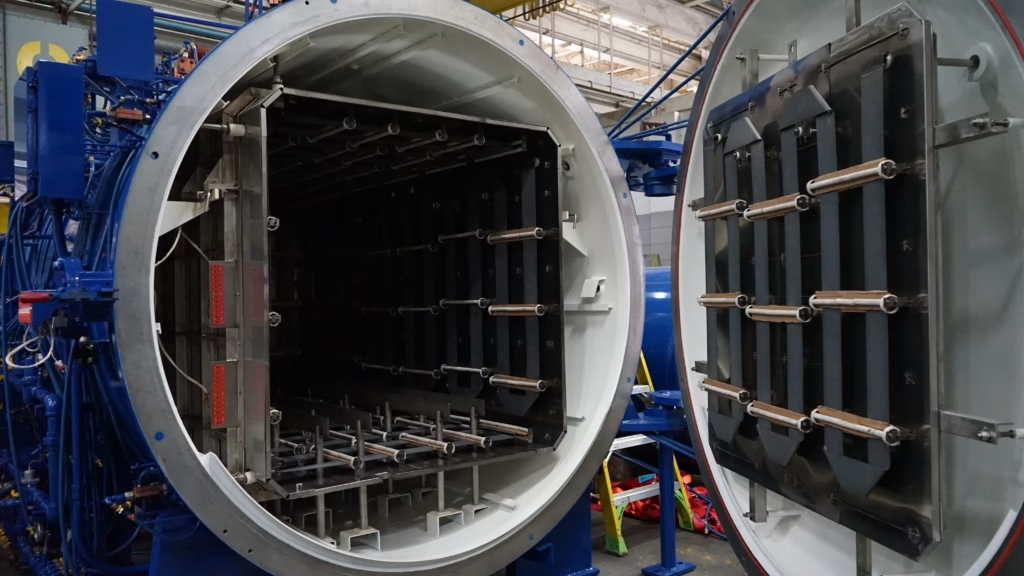
When operating a new furnace, new hot zone, or new hearth, it’s imperative to make sure the hearth is level across each axis.
Brazing is particularly sensitive to hearths and fixtures that are out of level. Gravity can affect the thickness of a brazed joint when one side of the part is higher than another.
If you’re experiencing runoff on one side of your hearth, or if you’re noticing an uneven braze from one side of your part or load as compared to the other side, be sure to check that your load is level. Shim your hearth or your furnace as needed and test your next batch to see if you’ve resolved the issue.
Q: When brazing, I’ve noticed that some of my parts are shifting on the fixture. I’ve had parts that are experiencing buckling, expansion, and unexpected stress on joints. What can I do to prevent that in the future?
A: Your furnace may be drawing down into vacuum too quickly.
Vacuum furnaces can draw down the atmosphere inside the hot zone very rapidly. Parts inside the chamber can experience a rapid pressure differential, with airflow comparable to the wind of a category 3 hurricane.
While there is no such thing as “too deep” of a vacuum, the rate at which that vacuum forms within the furnace can, in fact, happen too quickly for some parts.
Parts that have enclosed voids, parts with complex geometry, or small parts with low mass may experience enough rapid atmospheric change to shift, expand, or deform if the speed at which your initial vacuum evacuation happens too quickly. These are the forces that can create unexpected expansion coefficient issues.
Ipsen can help solve these issues by limiting and adjusting the speed at which the vacuum forms within your furnace with a slow-pump bypass. If you’re experiencing these issues, contact us to talk about installing an aftermarket bypass by calling 1-844-GO-IPSEN or emailing retrofits@ipsenusa.com.
For more helpful tips, visit our Ask the Expert Page.
 English
  German
  Chinese
  Japanese
  Italian
  French
  Spanish